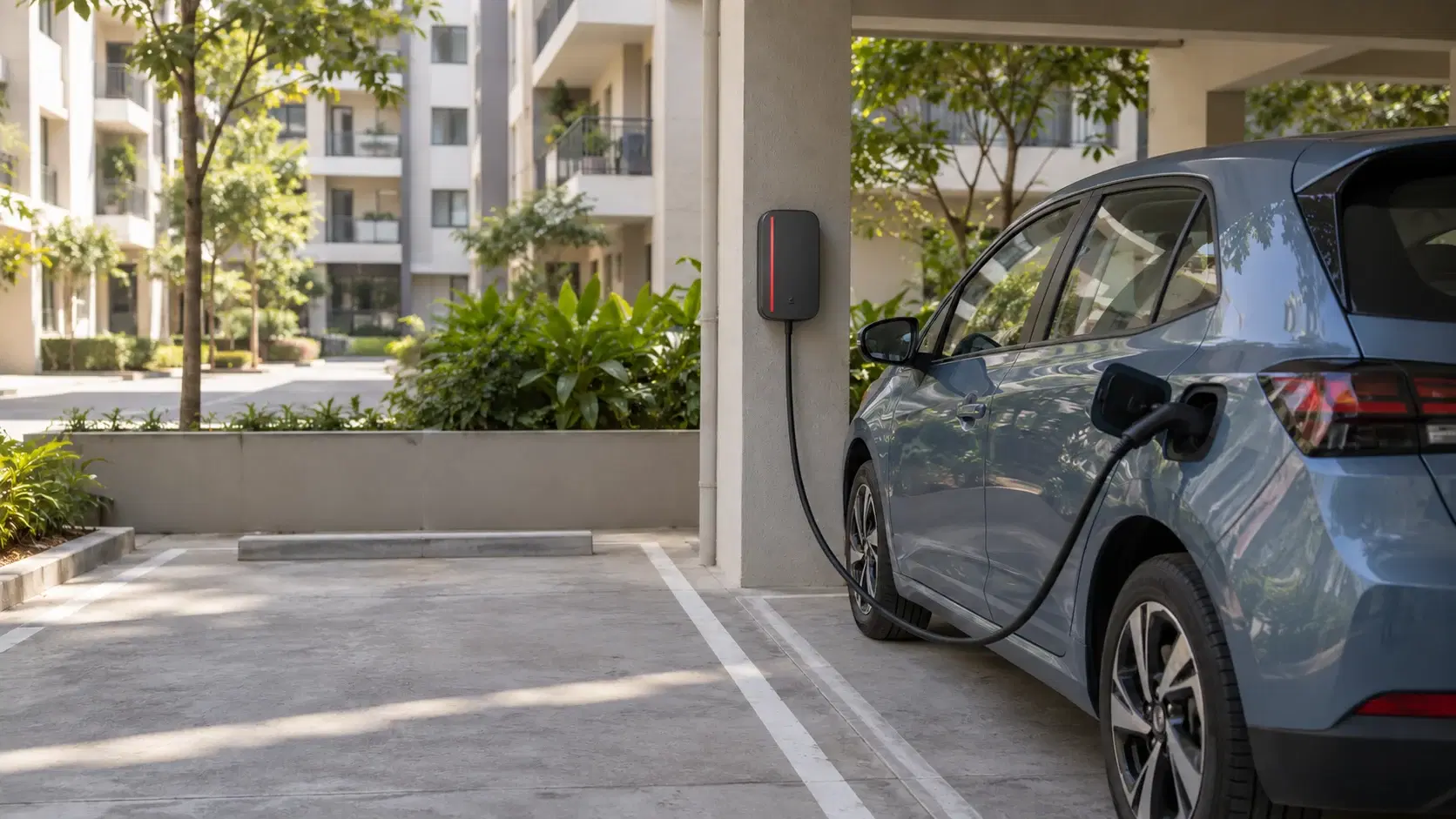
Start with what works today. Leave room for the next wave of EV owners.
EXPLANATORY SCHEMATIC · NOT AN ELECTRICAL DESIGN
Approved resident supply
Dedicated energy meter
Bay 01One resident
An approved supply and dedicated meter feed one charger in a resident’s assigned bay.
Option 01
Dedicated parking
A charger at an assigned bay, used by an authorised resident.
Convenient overnight charging
Resident meter or approved metering arrangement
Cable route and parking permission reviewed first
Discuss before installation
Confirm the supply, metering, cable route and permission for your assigned bay.
Smart load management
More cars. A smarter share of power.
The property has a power limit. A managed charging design can distribute the available capacity between connected vehicles, instead of asking every charger to run at maximum power together. Explore the difference.
Illustrative charging capacity36 kW
Allocated power36.0 kW
Property capacityWithin limit
Explore the 30-bay illustration
013.0 kW
023.0 kW
033.0 kW
043.0 kW
053.0 kW
063.0 kW
073.0 kW
083.0 kW
093.0 kW
103.0 kW
113.0 kW
123.0 kW
13Available
14Available
15Available
16Available
17Available
18Available
19Available
20Available
21Available
22Available
23Available
24Available
25Available
26Available
27Available
28Available
29Available
30Available
12 charging / 0 waiting for power. Waiting vehicles need scheduled rotation; no completion time is promised.
Illustration, not the EHUB control algorithm: 7.2 kW maximum and 1.4 kW minimum active power per single-phase charger; 36 kW reserved for EV charging. When capacity cannot support every connected car above the minimum, some wait rather than receiving unusably low power. Actual minimums, vehicle limits, phases, electrical design and available charging time vary. A site survey must confirm capacity and any upgrades.
Beyond the charger
The resident sees a session. The association sees the whole picture.
A coherent operating model connects access, metered energy, resident accounting and maintenance. Confirm the available software and payment features in your proposal.
RESIDENT · VISUALISATION
Good evening, Ananya.
Your parking. Your charging.
Parking B28 · Flat 1204
Charging in progress
18.4 kWh this session
₹220.80 estimated · payment due after charging
Access verifiedSession history
PROPERTY · VISUALISATION
One view of your community.
12Connected EVs36 kWAllocated power30Planned bays
ParkingResidentState
B28Flat 1204Charging
B29Flat 803Charging
B30Flat 602Scheduled
Interface visualisation. Features and power allocation depend on the chosen equipment and site controls.
Start with your property
Your EV-ready future. A clearer first step.
Three property details are enough to start a planning checklist. Add demand and electrical details only if you know them. No contact details needed.
Your plan stays in your browser. It does not send property details to EHUB or book a survey.
Optional planning tool · 3 essentials
A few details about your community.
Bring EHUB to my apartment
Start the conversation. Bring your community along.
Share a useful starting point with your apartment group. Ask who already owns an EV, who plans to buy one and who can help coordinate with the association.
Prepare a message to share with your group. No residents are registered and no contact details are collected.
A shareable introduction.
No contact details required. Share only with a group you are authorised to contact.
Ownership & operations
Agree the responsibilities. Then agree the investment.
Commercial arrangements must be confirmed in a property-specific proposal. Hardware, electrical works, electricity, software and maintenance should be quoted separately.
Charging funding models to discuss with EHUB
Possible arrangement
Hardware & infrastructure
Electricity & billing
Best suited to
Resident owned
Resident funds their charger; shared works need agreement.
Dedicated meter or separately measured reimbursement.
Assigned parking with approvals.
Association funded
Association funds common infrastructure and agreed chargers.
Resident usage is measured separately from common consumption.
Communities planning shared access.
Builder funded
Builder plans the electrical backbone and phased activation.
Operating responsibilities pass to the agreed property operator.
New developments and EV-ready parking.
Ownership, tariff, service scope, software fees and replacement responsibilities require written agreement. No standard price or savings are implied.
From first conversation to daily charging
Know what happens next.
01
Understand the property
You share parking, current EV demand and approval responsibilities.
02
Review the electrical system
A qualified team checks supply, protection, cable routes and available capacity.
03
Design & agree
Confirm phased infrastructure, commercial terms and maintenance scope before approval.
04
Install & commission
Install, test and hand over the agreed system with resident onboarding.
05
Operate & expand
Agree monitoring, support and maintenance; review capacity as EV adoption grows.
A sound installation
Ask to see the detail.
A considered installation goes beyond the charger. Ask for the proposed electrical design, equipment specifications, test and commissioning records, and the written support scope.
Site-specific capacity and protection plan
Itemised installation and maintenance responsibilities
Relevant equipment documentation and compatibility checks
Verified project references where available
Clear answers
The questions your community will ask.
Can I install a charger in my apartment parking?
An assigned parking bay can be a good starting point. Review the cable route, metering, electrical capacity and safety with your association and a qualified electrical professional before installation.
Does my RWA need to approve the installation?
Coordinate with the association or property manager before work affecting shared areas or electrical systems. The permissions and utility process depend on the property, connection and applicable local requirements.
Who pays for the electricity?
The charging user should have a clear accounting arrangement. This may use a resident’s electricity connection or an approved shared supply with individual energy measurement. Agree electricity charges, any service fees and reconciliation before commissioning.
Can electricity be recorded separately for each resident?
A suitable metering and charging management setup can associate energy with each authorised session. The proposal should specify meter accuracy, resident identification, tariff rules and reporting.
Can multiple chargers share the existing power capacity?
Load management can distribute an assessed charging power budget across connected vehicles. It does not create extra electrical capacity: transformer, sanctioned load, panels, cables and protection still need review, and upgrades may be necessary.
What happens when more residents buy EVs?
A phased plan reserves suitable cable routes and electrical provisions. Add chargers within the approved design, reassess demand and increase capacity when needed. A readiness estimate is not an electrical design.
Will it work with my Tata, Mahindra, MG, Hyundai, Kia or BYD?
Compatibility depends on the specific vehicle’s connector, onboard AC charging limit and the charger selected. Share the model and year during assessment; brand name alone does not confirm compatibility.
Can existing apartments be retrofitted?
Often a retrofit is possible, subject to electrical feasibility, parking arrangements, safe cable routes and permissions. A site survey establishes what can be reused and what needs upgrading.
Can a new building be EV ready before residents buy EVs?
Yes, an electrical design can plan ducts, routes, panel provision and charging bays ahead of demand. The design should allow phased activation rather than assuming every bay needs a live charger immediately.
How much will installation cost, and how long will it take?
Cable length, charger choice, metering, civil work, electrical upgrades and approvals affect cost and timing. Ask for an itemised proposal and a schedule after the site assessment; this page does not promise a fixed price or completion date.
What happens if a charger fails?
Agree monitoring, fault reporting, response expectations, warranty and replacement responsibility in the service contract. A support plan should name the party responsible for both hardware and software issues.
Can charging be limited to residents, with UPI payments?
Authorised access and payment methods depend on the chosen charger and management platform. Specify resident access rules, UPI availability, receipts, refunds and settlement responsibility in the proposal. Product examples on this page are illustrative.
What safety checks are needed?
A qualified professional should review earthing, protection, isolation, cable sizing and routing, environmental conditions, emergency access and applicable standards. Request the selected hardware’s documentation and the commissioning test record.
What happens during a power outage?
Charging normally pauses when the supply is unavailable. Restart behaviour depends on the charger and control system. Agree how sessions and billing are reconciled; backup charging must be specifically engineered.
Can solar or battery storage be added later?
Potential integration requires a separate feasibility review of the electrical design, controls and commercial arrangement. Reserve options in the plan where useful; solar or storage is not included automatically.
Prepare for the first conversation.
Bring a parking layout, current EV count and the name of the person responsible for electrical approvals. Share documents only through an agreed secure channel.